8 AI Content Creation Strategies Redefining Modern AI Marketing
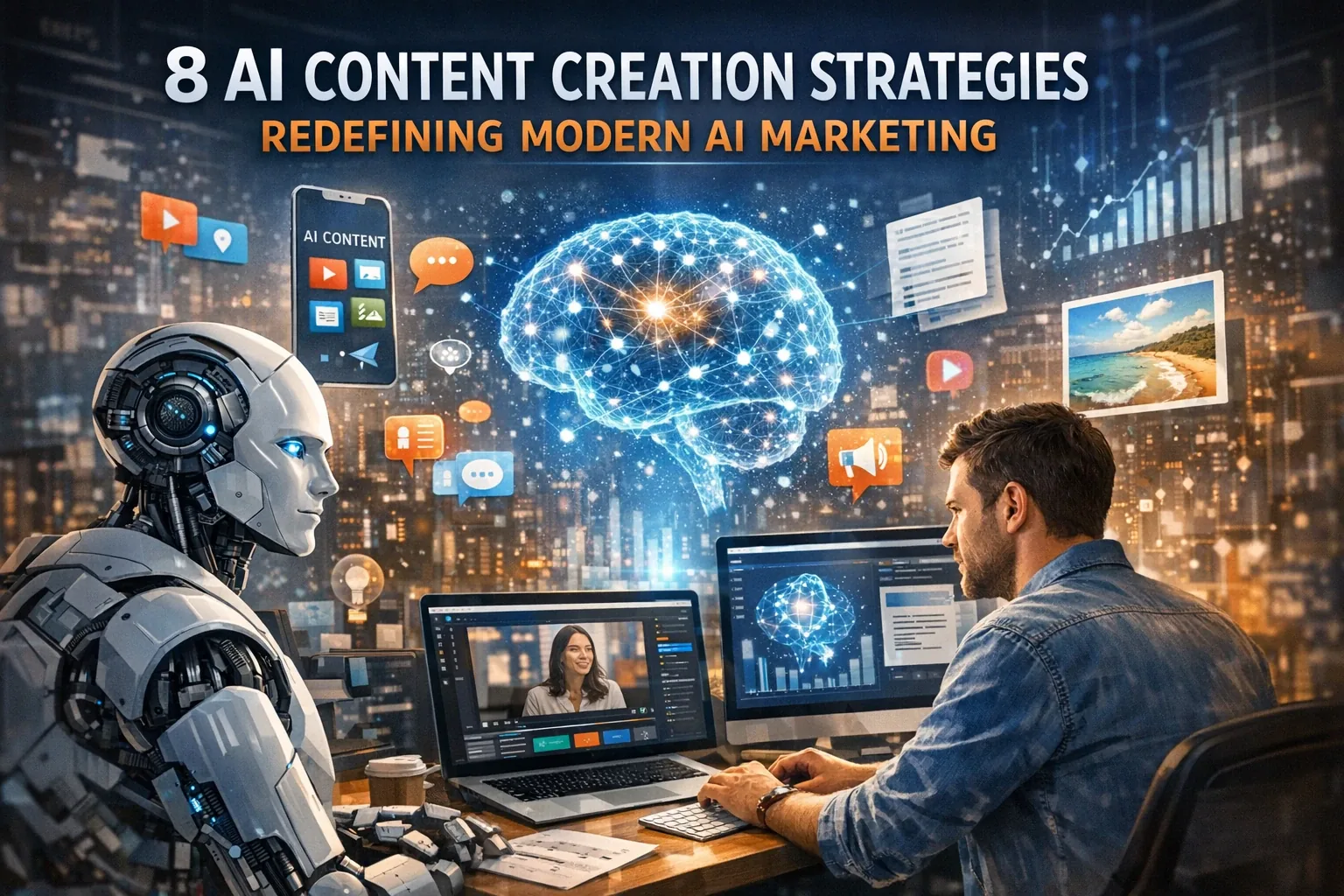
Artificial intelligence has become a foundational layer in modern marketing operations. From ideation to execution, AI is reshaping how content is planned, produced, optimized, and distributed across digital channels.
However, successful AI marketing is not about automation alone. It requires strategic thinking, ethical boundaries, and a clear understanding of how AI augments—rather than replaces—human creativity. This article explores eight AI content creation strategies that are actively shaping AI-driven marketing teams today, supported by real-world practices and practical examples.
1. AI-Assisted Ideation Supports Always-On Content Marketing
One of the most widely adopted uses of AI in marketing is content ideation. AI systems can analyze large volumes of search behavior, social engagement, and competitive content to suggest topics aligned with audience demand.
According to industry research from HubSpot and Gartner, marketing teams using AI for ideation report faster campaign planning cycles and improved content consistency. The most effective teams treat AI-generated ideas as directional input, not final decisions.
Best practice:
Use AI to expand topic coverage, then apply human judgment to prioritize ideas that align with brand positioning and campaign objectives.
2. Multimodal AI Content Is Reshaping Engagement Strategies
AI marketing is increasingly multimodal. Text alone is no longer sufficient to capture attention across platforms dominated by video, audio, and interactive media.
AI-generated audio and music now play a growing role in content experiences—especially for short-form video, product explainers, and branded storytelling. Instead of relying solely on static assets, marketers are experimenting with dynamic sound elements that reinforce emotional tone.
Case Example: MusicAI in Multimedia Content Production
In multimedia marketing workflows, AI music generators like MusicAI are used to rapidly create background tracks that match specific moods or pacing requirements. This allows content teams to prototype audiovisual concepts earlier in the creative process, reducing dependency on stock libraries or lengthy production cycles.
For AI marketing teams, this approach enables faster iteration while maintaining originality across channels.
3. AI-Enhanced SEO Focuses on Intent, Not Just Keywords
Search engine optimization has evolved significantly in the AI era. While keywords remain important, modern SEO emphasizes search intent, topical authority, and content structure.
AI tools help marketers analyze SERP patterns, identify content gaps, and optimize formatting for readability. Research from Search Engine Journal shows that content aligned with user intent consistently outperforms keyword-heavy pages in long-term rankings.
Key insight:
AI supports optimization decisions, but clarity and usefulness still determine success. Well-structured, reader-first content remains essential.
4. Productivity Gains Through Workflow Automation—Not Creative Replacement
AI marketing success depends on efficiency without burnout. AI excels at handling repetitive tasks such as summarization, content formatting, and draft generation, allowing marketers to focus on strategy and storytelling.
McKinsey research suggests AI-assisted workflows can reduce time spent on routine marketing tasks by up to 30%. However, productivity gains are maximized when AI is integrated selectively rather than universally.
Strategic approach:
Apply AI where friction exists, not where creativity thrives.
5. AI-Powered Content Pipelines Enable Faster Campaign Execution
In AI marketing environments, content is rarely created in isolation. AI tools are increasingly embedded across entire marketing pipelines—from planning and creation to distribution and performance analysis.
Marketing teams may combine AI-generated drafts, AI-assisted visuals, and predictive analytics to optimize campaign performance in real time. This integrated approach supports faster execution without sacrificing message consistency.
The most effective pipelines maintain human oversight at key decision points, ensuring brand voice and strategic alignment remain intact.
6. Case Study: MusicArt Supporting Rapid Creative Experimentation
AI Tools as Creative Prototyping Accelerators
Smaller marketing teams and independent creators often rely on AI tools to validate ideas quickly. In early-stage campaign development, AI-generated creative assets help teams test emotional resonance before committing to full production.
MusicArt has been used in such workflows to generate mood-based music tracks that support video drafts or concept previews. By pairing AI-generated audio with early visual content, marketers can assess tone and audience fit earlier in the process.
This approach illustrates how AI tools function as creative accelerators, not final arbiters. Human-led refinement remains essential.
7. Ethical Considerations in AI Marketing Content
As AI adoption increases, ethical responsibility becomes central to content strategy. Audiences expect transparency, originality, and authenticity—even when AI tools are involved.
Key ethical considerations include:
- Ensuring AI-generated content is reviewed and edited by humans
- Avoiding misleading or overly automated messaging
- Respecting intellectual property and originality standards
AI should enhance creative capability without obscuring authorship or intent.
8. The Future of AI Content Creation in Marketing
Looking ahead, AI content creation is moving toward greater contextual awareness and cross-channel integration. Future systems will better understand brand tone, audience segmentation, and performance feedback loops.
AI marketing teams will increasingly operate within adaptive content ecosystems, where insights from analytics directly inform creative decisions across formats.
The defining factor will not be AI capability alone—but how strategically it is applied.
Key Takeaways for AI Marketing Teams
- AI enables scalable ideation and faster execution
- Multimodal content, including AI-generated music, enhances engagement
- SEO success depends on intent and structure, not automation
- AI productivity gains require selective integration
- Ethical oversight remains critical to long-term trust
- The future of AI marketing lies in human–AI collaboration